By Mauricio Sordille — Head of Growth Marketing, MMPG
For the last few years, programmatic SEO felt like a cheat code.
- Build thousands of pages.
- Target long-tail keywords.
- Scale content faster than competitors.
- Watch impressions climb every single day.
That was my reality with GetNameHub.
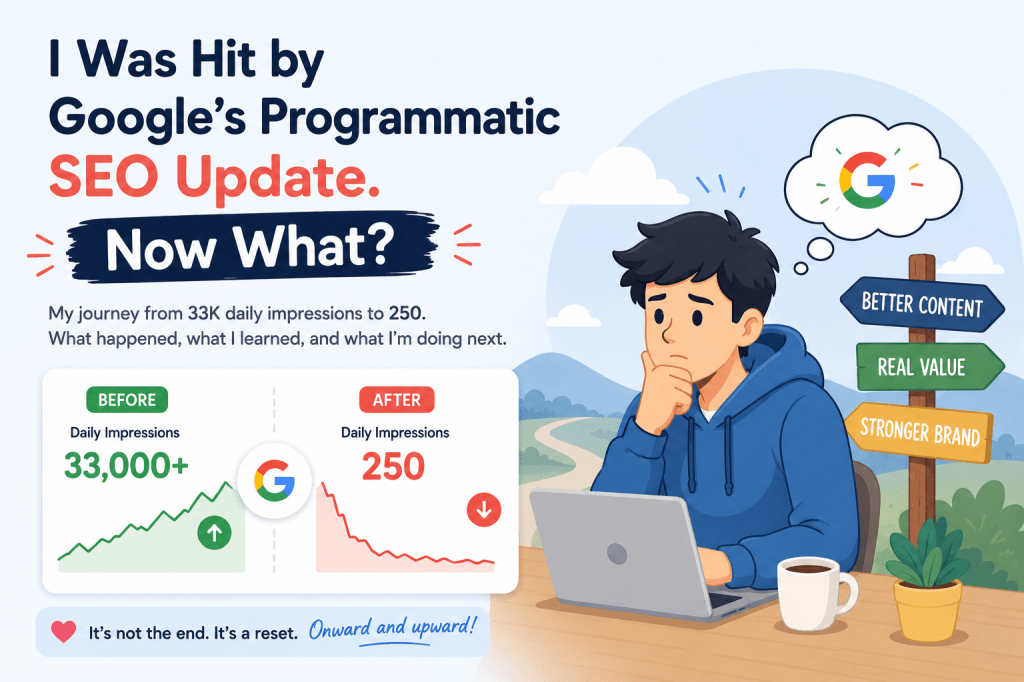
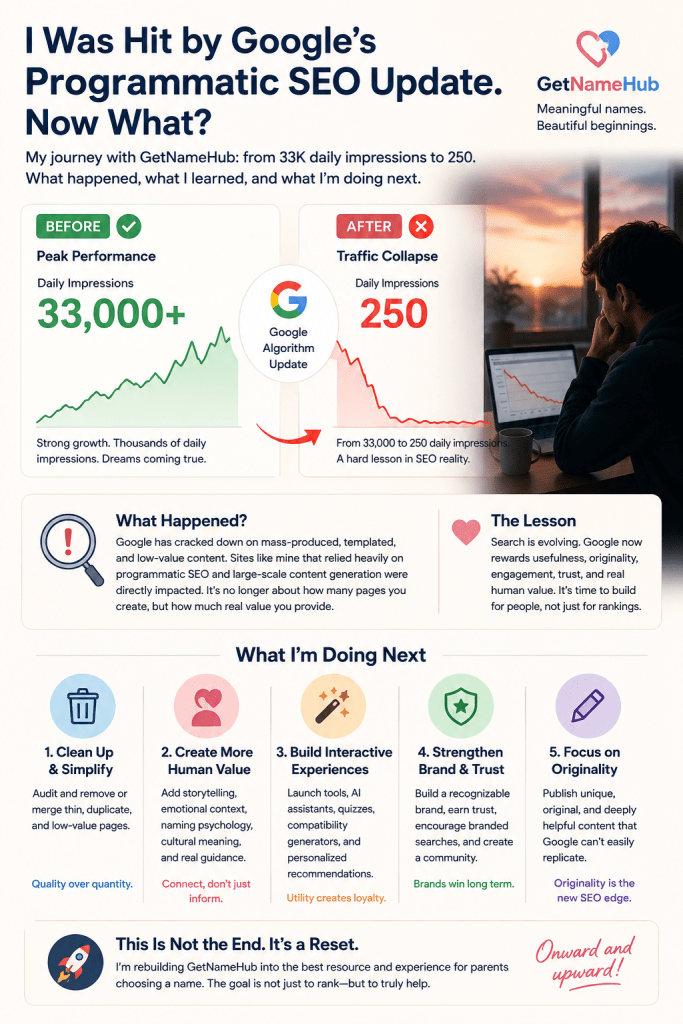
At its peak, the website was reaching more than 33,000 daily Google impressions, the growth was exciting. Every new cluster of baby names, meanings, origins, and generators seemed to unlock more visibility.
Then it happened.
The traffic collapsed.
Not slowly.
Not gracefully.
Almost overnight.
Daily impressions dropped from around 33,000 to barely 250.
At first, I thought:
- maybe it was a technical issue,
- maybe indexing problems,
- maybe a temporary Google bug.
But after weeks of analyzing the site, studying SEO communities, reviewing updates, and understanding where Google Search is heading, the reality became impossible to ignore:
Google fundamentally changed how it evaluates large-scale programmatic websites.
And sites like mine were directly in the crossfire.
What Actually Happened?
Google has been evolving rapidly toward a new type of search ecosystem.
The old SEO world rewarded:
- scale,
- keyword coverage,
- volume,
- templated content,
- and long-tail domination.
The new Google rewards:
- usefulness,
- originality,
- engagement,
- trust,
- and real human value.
That sounds simple in theory.
But for websites built around programmatic SEO, it changes everything.
The Rise — And Problem — of Programmatic SEO
Programmatic SEO became popular because it worked incredibly well.
If someone searched:
- “Emma name meaning”
- “Unique Irish girl names”
- “Biblical baby names starting with M”
You could create highly optimized pages at scale and rank for thousands of variations.
For baby-name websites, this strategy was everywhere.
Including mine.
The issue is that Google became extremely good at recognizing:
- repeated templates,
- similar semantic structures,
- mass-generated content,
- and pages created primarily for search engines instead of humans.
Even if the content was technically “helpful,” Google started asking a deeper question:
“Would a human intentionally bookmark, share, revisit, or emotionally connect with this page?”
That question changed the game.
Why GetNameHub Was Vulnerable
Looking back honestly, I can see the signals Google probably detected.
Many pages followed similar patterns:
- same structure,
- similar phrasing,
- similar intent,
- repeated formatting,
- and scaled publishing behavior.
Even though the website contained useful information, the overall experience may have looked too programmatic from Google’s perspective.
And the baby-name niche itself has become extremely saturated with:
- AI-generated content,
- automated databases,
- scraped meanings,
- and low-effort SEO pages.
Google likely began classifying many name websites as “commodity content.”
That hurts.
But it also forced me to rethink everything.
The Hardest Part About Losing Traffic
The hardest part is not watching numbers go down.
It’s realizing that the strategy you spent years building around may no longer work the same way.
As SEO professionals, developers, founders, and creators, we sometimes forget something important:
Google does not owe us traffic.
Search evolves.
And honestly, users evolve too.
People no longer want endless lists of names with generic descriptions.
They want:
- guidance,
- personalization,
- emotional connection,
- confidence,
- and experiences.
Especially future parents.
Choosing a baby name is emotional.
It’s personal.
Sometimes spiritual.
Sometimes cultural.
Sometimes deeply tied to family history.
A database alone is no longer enough.
So… What Now?
This is the part where many websites die.
Some owners panic:
- publish even more pages,
- buy backlinks,
- spam AI content,
- or chase loopholes.
I’m choosing a different direction.
Instead of trying to out-scale Google, I want to build something Google cannot easily replace.
The Future of GetNameHub
The next version of GetNameHub will focus less on mass production and more on real usefulness.
That means shifting from:
“a giant name database”
to:
“a real decision-support platform for parents.”
What I’m Changing
1. Reducing Thin & Repetitive Pages
Not every indexed page deserves to exist.
I’ll be auditing:
- low-value pages,
- duplicate intent pages,
- thin content,
- and overly similar structures.
Some pages will be:
- merged,
- rewritten,
- improved,
- or removed entirely.
Sometimes less really is more.
2. Creating More Human Experiences
Instead of generic descriptions, I want pages that feel alive.
That includes:
- emotional storytelling,
- cultural context,
- naming psychology,
- sibling name compatibility,
- pronunciation help,
- astrology and personality ideas,
- middle-name matching,
- and real-world inspiration.
Parents are not searching for data.
They’re searching for feelings.
3. Building Interactive Tools
Google increasingly rewards utility.
That means creating experiences people actually use:
- AI naming assistants,
- personalized name recommendations,
- compatibility generators,
- naming quizzes,
- save/share features,
- and interactive discovery tools.
The future of SEO is not just content.
It’s experience.
4. Focusing on Brand Instead of Volume
One of the clearest lessons from this update:
Google trusts brands more than anonymous content factories.
That means I need to build:
- direct audience relationships,
- returning visitors,
- branded searches,
- community,
- and trust.
The goal is no longer:
“How many pages can I create?”
The goal becomes:
“Would people intentionally come back?”
5. Making Content More Original
AI can generate information.
But it cannot easily replicate:
- human stories,
- emotional nuance,
- lived experiences,
- or authentic perspectives.
The internet is entering an era where originality matters again.
And honestly, that’s a good thing.
Programmatic SEO Is Not Dead
This is important.
Programmatic SEO still works.
But low-value programmatic SEO is becoming extremely risky.
The future belongs to websites that combine:
- scale,
- utility,
- personalization,
- and authentic value.
In other words:
programmatic SEO must evolve into product-driven SEO.
Final Thoughts
Watching a website collapse from 33,000 daily impressions to 250 is painful.
There’s no way around that.
But sometimes losing traffic forces you to build something better.
I don’t believe the future belongs to websites trying to manipulate search engines.
I believe the future belongs to websites that genuinely help people make decisions, solve problems, and feel understood.
For me, this is not the end of GetNameHub.
It’s the reset button.
And honestly?
It might become something far more valuable because of it.m. We’re here to make sure you find the right one.
Mauricio Sordille Head of Growth Marketing — MMPG Digital Marketing Agency 📧 contact@mmpgoals.com | ☎️ 510-384-0208
Ready to grow your platform? Let’s talk.

 MMPG
MMPG 
Leave a comment