
Conventional SaaS marketing wisdom says: go simple, emotional, and obvious on your landing page. Spotlight the pain, promise the relief, throw in proof, and seal the deal with a single, irresistible Call To Action (CTA). In fast-moving B2B categories, that formula works.
But what happens if your prospective users are:
- Highly educated, risk-averse attorneys, trained to challenge assumptions and interrogate the fine print.
- Living with real professional consequences for every misstep, oversight, or wasted minute.
- Steeped in a world defined by nuance, regulatory complexity, and three decades of institutional inertia
For firms handling hundreds or even thousands of high-stakes cases a year, trust isn’t a tagline. It’s existential.
A smiling stock photo and a “Book a Demo” button just won’t cut it.
What Lawyers Actually Need: Trust, Clarity, and a New Mental Model
Let’s back this up with real data:
- 46% of law firm decision-makers cite “risk of disruption” as the top barrier to new software adoption. (Law.com Survey)
- 60%+ say “clear, immediate ROI” and “workflow compatibility” matter far more than features or price.
Lawyers live in a world where choices must be justified, to partners, to clients, sometimes even to courts. Their first visit isn’t for a dopamine hit; it’s a search for proof that your technology is built for their gravitas.
What do they actually want?
- The why and how behind your claim of “enterprise-grade”
- Real-world examples of how your system beats the document chaos, not just demo screenshots
- Direct answers to: Will it simplify my life, or add a new layer of digital headaches?
This is why a landing page for Deliberately.ai, a new category of software called “Legal Software Management tool” and not just a “tool”, can’t follow the old SaaS playbook.

From Feature Lists to Mental Model Shifts: A Reframing Marketers Must Grasp
When Deliberately.ai created the category of Client Intelligence, it wasn’t a gimmick. It was a necessary reframing. Traditional legal tech is built around tools: time trackers, billing apps, form generators. We’re not that. We’re a foundational platform that thinks.
So how do you explain that in a headline?
- “Eliminate administrative triage”? Too vague.
- “Built-in multi-agent orchestration”? Too technical.
- “Don’t burn out—build leverage”? Closer, but still abstract.
Deliberately.ai isn’t a widget bolted to the old machine; it’s a new operating system, a new way of knowing who your clients are and what their legal needs demand. This means you’re not just selling a product. You’re selling a higher-order transformation:
- From “information triage” to strategic clarity
- From “late-night admin” to automated, instantaneous insight
- From “trust, but verify” by hand; to trust and verify, automatically
Real-World Example: What Legal Buyers Actually See
Take a managing partner at a 10-attorney family law firm. She’s survived three software upgrades and watched CRMs “built for law” burn hundreds of hours and break document chains. She Googles “AI for law firms” and lands on your site. She’s not thinking, “cool, another dashboard.” She’s thinking:
- Will this actually reduce risk?
- How will this fit our intake, our disclosures, our deadlines?
- Can it defend its claims with results, not rhetoric?
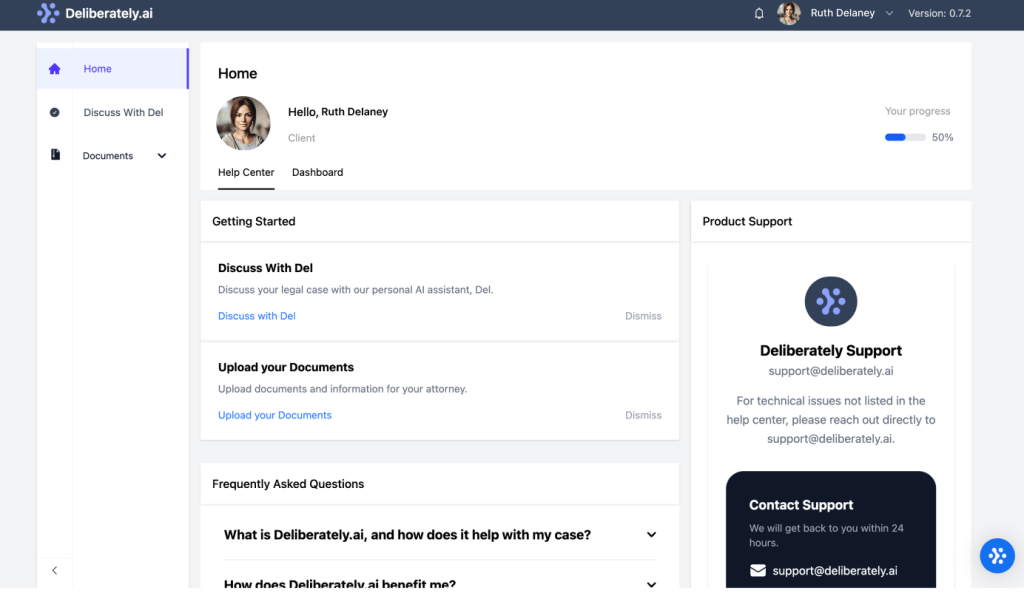
This attorney isn’t just evaluating software; she’s evaluating reputational threat, workflow redesign, and the sleep her team loses chasing evidence across emails, scans, and sticky notes.
Winning Trust: Build Context, Not Just a CTA

For enterprise applications like Deliberately.ai, your landing page is never the full conversation. The most successful SaaS marketers invest in a gravity well of context—because for legal buyers, trust is built across touches, not clicks.
Key strategies:
- Deep-dive explainers on how your client intelligence fights legal document chaos (use real statistics: e.g., “Firms using AI-driven document management spend 37% less paralegal time searching and assembling evidence.”)
- Webinars and workflow demos featuring real attorneys (“How a 5-attorney firm in San Mateo used Deliberately.ai to cut document intake time in half, reduce missed deadlines, and outperform larger competitors.”)
- Thought leadership: White papers, Continuing Legal Education (CLE) content, and LinkedIn posts addressing issues like data integrity, compliance, and tech fatigue—written for attorneys, not just tech buyers.
Every touchpoint is designed to meet attorneys where they are: skeptical, overloaded, and starved for clarity.
CRO for Enterprise Legal SaaS: Practical Steps Backed by Data
What moves the needle for conversions with this audience?
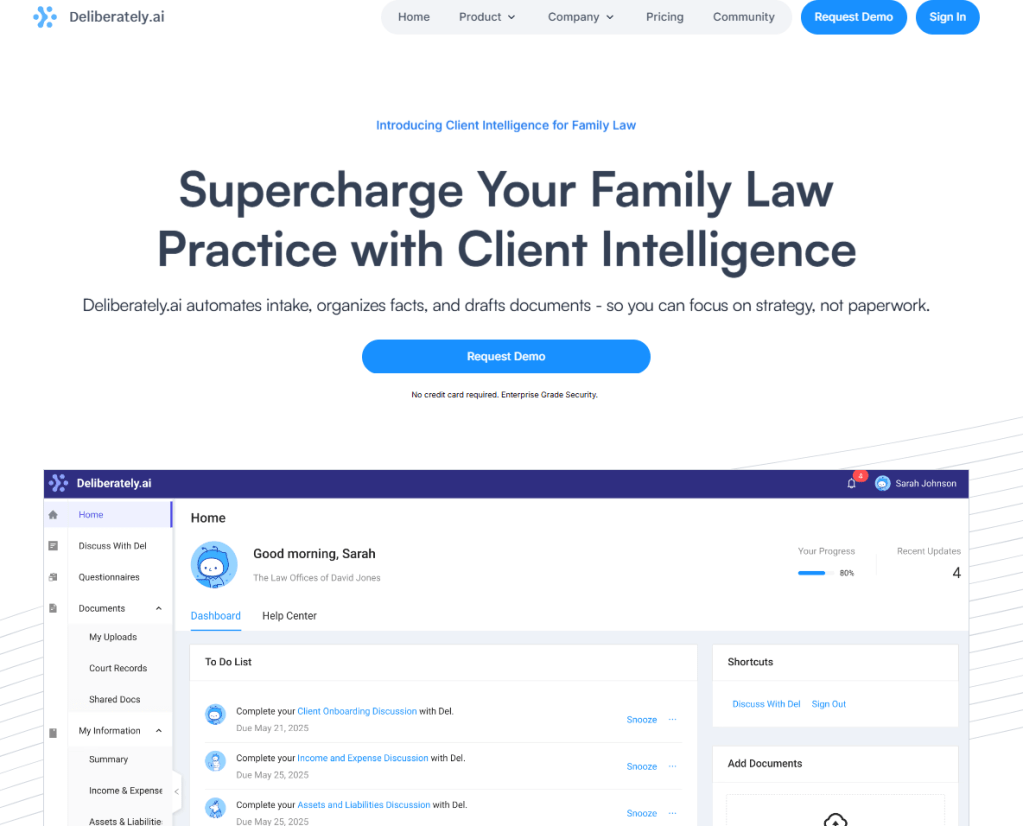
- Above-the-Fold with Substance: Use sharp, client-centric headlines: “Instantly surface every fact and filing for 250+ ongoing matters. Powered by AI. Built for law.”
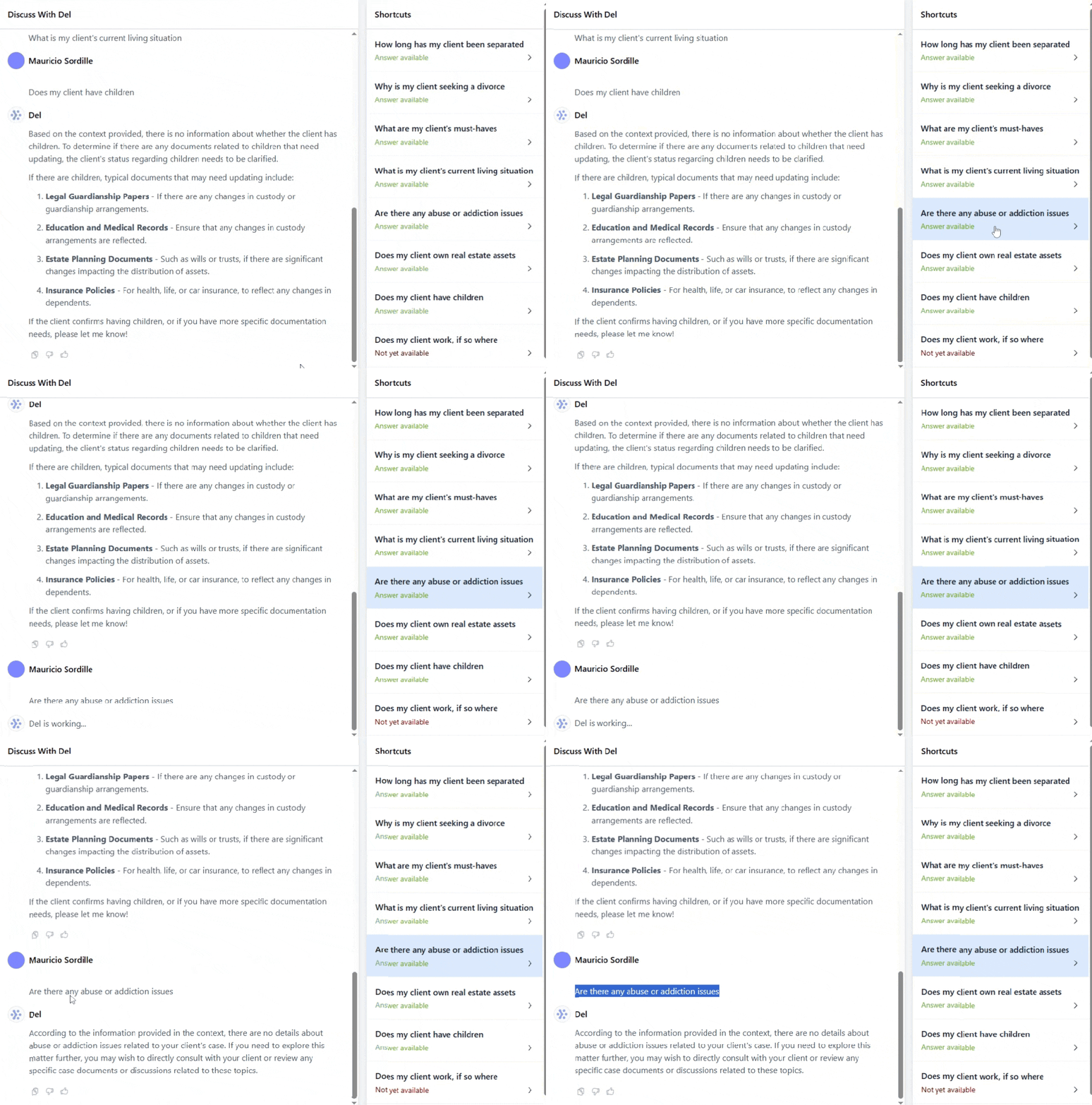
- Visuals that Show, Not Just Tell: Attorneys want to see how your system integrates (not just looks pretty). Replace generic dashboards with GIFs or short clips of real workflows—dragging in a scanned declaration, instantly seeing extracted data and gaps, etc.
- Trust Elements Anchored in Professional Proof: Badges from legal associations, user testimonials from named attorneys, data points (“$12,500 hours saved in Q1”), CLE partnerships.
- Device Optimization & Sticky CTAs: 40% of B2B legal site visits are now mobile, but mobile conversion still lags by 35%+—so maintain easy navigation, urgent but respectful CTAs (“Request Demo | Download Case Study”) and simplified, low-friction sign-up (no more than 3 fields).
- Metrics Beyond Clicks: Beyond conversion rate, track scroll depth, CTA click-throughs, demo requests, and direct questions from contact forms. Every high-intent interaction signals trust and readiness.
Relationship, Not Funnel
Landing pages don’t close the deal. In legal tech, the journey looks like this:
- A partner sees a Deliberately.ai case study on LinkedIn
- The firm’s admin finds a detailed explainer video
- The managing partner clicks through from Google, skims the homepage, then leaves
- Weeks later, after wrestling with another intake disaster, someone remembers your “client intelligence, not just automation” promise
- A question comes to your chat or contact form—and only after multiple trust-building moments does the sales call get booked
That’s not a funnel.
It’s a chain of micro-conversions.
It’s a relationship.
That’s how belief in transformative tech is built.
The End: Earning Trust Is the Real Conversion
Building a marketing engine for Deliberately.ai isn’t just about landing more calls or clicks. It’s about helping attorneys move from skepticism to confidence: to trust that this is a better, safer, smarter way to run their firm, and the only foundation worthy of real legal practice.
You’re not just optimizing for lead gen. You’re guiding a generational leap in the way law is delivered; one moment of clarity, proof, and authority at a time.
And if you get this right? You don’t just win business.
You win the future of law.
Family Law Firm AI Software – Watch the full interview!

 MMPG
MMPG 
Leave a comment